Explanatory Feature
AI Transforms the U.S. Workplace: A Surging Adaptation
The release of ChatGPT in 2022 sparked its rapid integration into the American work day.
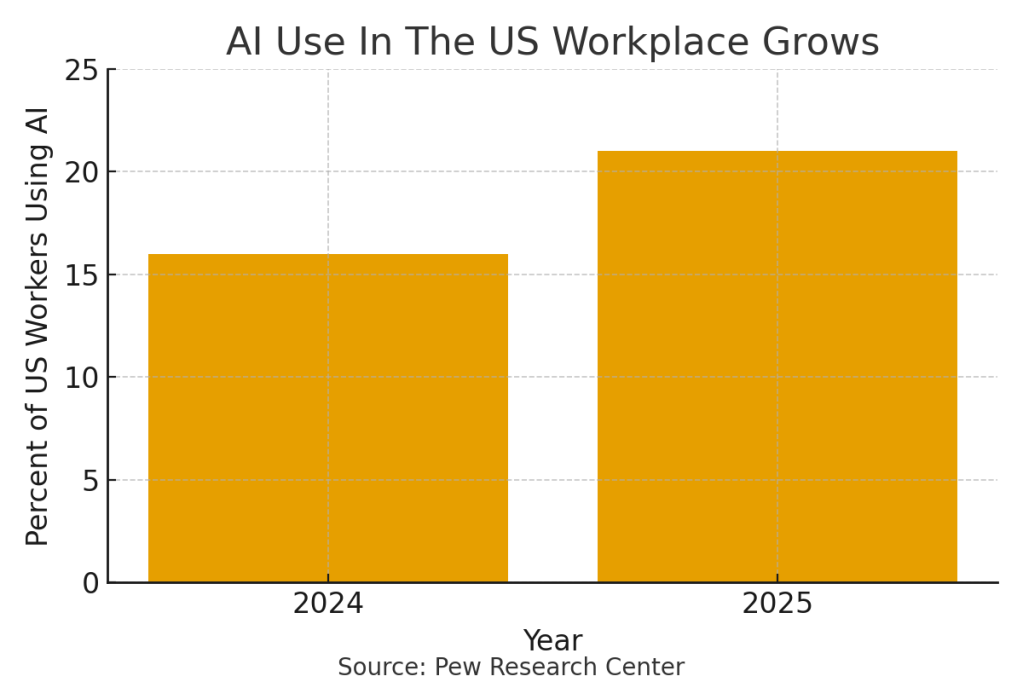
A Pew Research study stated some 21% of U.S. workers report some of their work is now done by AI, up from 16% in 2024,
Since ChatGPT’s release, OpenAI has spread faster than TikTok and Instagram, according to Time Magazine.
Employers across America have implemented AI technology into their spaces. A study by the Harvard Business School reports AI can improve a worker’s performance by nearly 40% compared to workers not using AI.
Some employees like Stephanie Lack, a project manager in IT at Hewlett-Packard Enterprise, have embraced the change and begun using AI at work daily.
“It is anywhere from a 10 minute to 4 hour time savings, to have this tool do that for us,” Lack said.
At the end of a full day of meetings, she finds it challenging to summarize and designate responsibilities. AI can now do it for her.
“The more you use it, the smarter it gets, and it writes notes that now sound like me,” she said.
Since her company has fallen short on hiring interns, AI has replaced their role of assistance.
Pawin Taechoyotin, a PhD candidate in computer science at the University of Colorado, Boulder, incorporates AI into his work while remaining wary of the tools’ long-term effects on learning.
He uses AI to learn what mistakes he made after creating the code himself.
“I think clearly of what I need and what I want before actually going and searching for it,” Taechoyotin said. “AI is just an authentication tool to help me get answers fast.”
Special education teacher at North Denver High School, Leslie Lillo, uses Magic School AI to make individual education plans and accommodations for her students in special education.
“Basically all that really good stuff that would take me forever to find, I can just ask,” she said. “Her name is Reina. We’ve become friends.”
AI has also contributed to new classroom challenges. Lillo knows one teacher now requires that all essays are handwritten in-person.
“They’re having it do their whole assignment for them and then copying and pasting it,” Lillo said.
As the use of AI in the workplace rises, employees are increasingly aware they may be training their replacements.
Lack anticipates downsizing in her department. She believes maintaining AI literacy will keep her employed.
“It’s a win-win. I get to learn something to make my job easier and potentially stick around longer,” she said.
36% of Americans say some of their work could be done with AI, up from 31% in 2024, according to Pew Research.
Taechoyotin offers a middle ground between skepticism and oversight.
“People say AI hallucinates, but I think people hallucinate it,” Taechoyotin said. “You have to take everything with a grain of salt, that’s going to protect you from making silly mistakes.”
Many workers fear AI will extenuate economic disparities, others hope it will create room for opportunity.
Lillo is concerned automation will hurt workers with the least power.
“People that are all about making money off the ‘little guy down below’, they’re going to love AI. It’s the ‘little people’ who have concerns,” she said.
Alternatively, Lack stays hopeful that AI could help people find better roles quicker.
“I think we’ll be able to use it for people to really find their strengths better, faster, easier,” Lack said.
The future of AI in the workplace remains uncertain, but current research anticipates incorporation at a steady rate.
“Keep an open mind, because AI was designed to help everyone in every field,” Taechoyotin said.
 Gianna Solari